


For a short while, sitting in my car on the side of the road with a flat tyre, I was convinced the universe was punishing me. I wanted to blame something for my situation, and while I waited for the road-assist to bring me a replacement tyre, I started reflecting on entanglement.
Physicists believe that when the early universe was dense and small, particles were close together and constantly interacting. Two particles can become so deeply linked, or entangled, that they behave as a pair sharing a single story, even when separated by vast distances, like the other side of the galaxy. Measuring one particle instantly reveals the correlated state of its partner. These particles don’t transmit information faster than light and then change to match one another; it is as if they instantly “know” what is happening to the other. This is a very basic explanation of quantum entanglement. Albert Einstein found this instantaneous connection between particles so unsettling that he called it “spooky action at a distance” because it challenged classical ideas of locality.

If you are not completely confused by quantum mechanics, you do not understand it – John Wheeler.
The prelude to my dilemma began the day before at 13:00, when our scrub sister phoned to tell me theatre temperatures were high and suggested I consider cancelling my theatre case the next day. I pushed back, saying it might be a small problem that could be fixed quickly, so I’d assess the situation the next morning, and that it isn’t good practice to cancel cases the day before based on what-ifs. In the middle of nowhere, next to the road, it felt like the universe had been trying to tell me something since the day before. I gave myself a reality check and realised the universe didn’t put me in this situation. I was stranded with a flat tyre because I focused on opening the muffin I wanted to eat while driving instead of paying attention to the steering wheel, and I swerved off the road, ever so slightly. Kudos to Eduardo from Porsche Assist, who came at 6:30 in the morning with a smile on his face, didn’t roll his eyes or comment on a woman driving a sports car, swiftly replaced my tyre with a temporary one, and gallantly assumed I’d hit a pothole on an open highway. I was on time for the theatre case, but walked into a theatre at 25°C and had to cancel the case. A lot of drama, and money, for nothing.

When the time comes for you to make a change or grow, the universe will make you so uncomfortable you will eventually have no choice – Unknown.
I don’t have a special interest in quantum physics; I know nothing about it, and what little I do understand sounds far-fetched to me. However, I’ve been watching the series Dark Matter on Apple, based on Blake Crouch’s sci-fi thriller novel, and I’ve found it extremely thought-provoking. In one episode, the main character, Jason Dessen, explains entanglement like this: imagine two coins flipped in different cities; each lands on heads or tails at random, but they always land opposite. Neither coin decides anything on its own; they’re linked from the start, and you only find out when you are aware of the entanglement and look for it.
It’s terrifying when you consider that every thought we have, every choice we could possibly make, branches off into a new world – Dark Matter, Apple.
The series Dark Matter revolves around another step in quantum physics before entanglement happens: superposition. Superposition is the ingredient, and entanglement is what you get when you combine two particles in superposition. To use the coin analogy again: the coins are in superposition while they spin, and because they are linked, they no longer have their own definite state; only the pair does. So you might have two coins spinning “undecidedly”, but because they are entangled, if one lands on heads, the other will land on tails. Superposition is “I haven’t decided yet, but we have agreed to be opposite”.
In Dark Matter, the main character, Jason Dessen, is a quantum physicist who found a way to put himself into superposition – literally. While in superposition, the “undecided state”, he can visit different realities stemming from every decision he ever made and meet different versions of himself. The series becomes interesting when he visits a version of himself who seems to have a better reality. In this reality, Jason stayed a university physics professor, got married, and started a family. The ambitious quantum physicist version of Jason wanted that life, and so he kidnapped the Jason of that reality and lived with the family as an impostor.
The paradox is only a conflict between reality and your feeling of what reality ought to be – Richard Feynman.
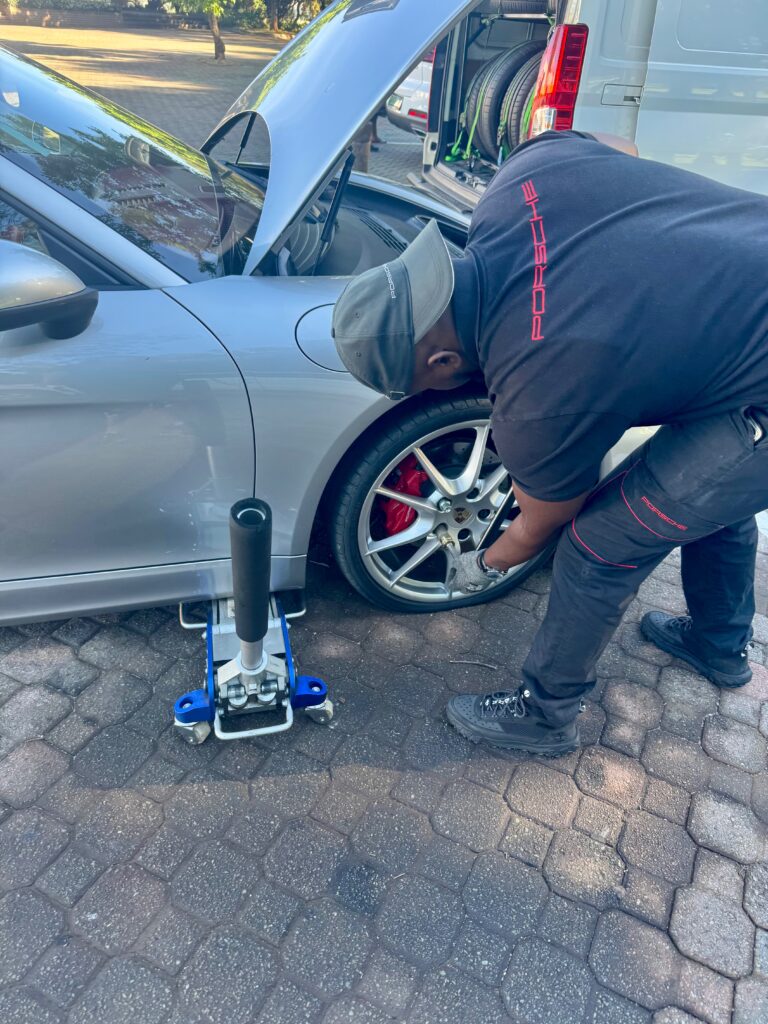
The next day, I was sitting at the Porsche service centre, patiently waiting for the mechanics to remove the temporary tyre and fit a new one, with quantum physics still on my mind. Wouldn’t it be nice to visit myself in different realities? What would the Rentia be doing today that cancelled the theatre case yesterday? Who would the Rentia be that didn’t become a cardiothoracic surgeon? What would the reality be like where my Mom were still alive? How I wish I could visit those realities and see what those Rentias’ lives are like. I stopped my reverie and tried to make sense of how quantum physics applies to me. I think the bottom line of quantum entanglement is that at the deepest level, things we assumed were separate aren’t as separate as they seem. Quantum entanglement shows that connection isn’t just poetic; it’s built into how reality works. I realised I am metaphorically in “superposition” all the time. Until I commit to a decision or a reaction, many versions of my future remain open.

Small shifts in your thinking, and small changes in your energy, can lead to massive alterations of your end result – Kevin L. Michel, Moving Through Parallel Worlds to Achieve Your Dreams.
Kevin L. Michel, the author of Moving Through Parallel Worlds to Achieve Your Dreams, draws on quantum language to make his point. He writes that just as entangled particles share one state, our inner world and our outer life aren’t truly separate. How we see ourselves shapes how we act, and how we act shapes who we meet and what we build. Shifting one’s subconscious can change one’s situation. Physics doesn’t tell us that our thoughts rewrite reality, but it does remind us that nothing exists in isolation, and that includes the story we tell ourselves.
Two versions of me can face the same flat tyre and walk away with entirely different stories, because what happens to us is only half the picture. The other half is how we respond to it. Awareness is the pause in that moment. It’s the gap where we notice a reaction arising and realise we have a choice about what to do with it. Without awareness, we run on autopilot: our subconscious beliefs about ourselves quietly steer how we read each situation, and our responses often confirm the very beliefs that produced them. If a part of me believes that I had a flat tyre because things never work out for me, I will notice every setback and shrug off every success, and my life will seem to prove me right.

It all begins and ends in your mind. What you give power to has power over you if you allow it – Unknown.
Quantum physicists also believe in randomness. They believe that in many situations one can only predict the probability of an outcome and not the outcome itself. So you don’t know whether the coin you’re watching will land on heads or tails, only that it will be opposite to the other. This randomness troubled Einstein, who believed the universe was orderly and that every effect has a definite cause. He believed quantum theory was incomplete, and he was widely criticised for that view. Later experiments showed that Einstein’s hidden-variable explanation doesn’t hold, but his discomfort drove the field forward. For me, the hidden variable Einstein was looking for is awareness. There is order in entanglement. We are not separate spectators to the world we live in. Our beliefs shape what we notice, what we notice shapes how we act, and how we act shapes what comes back to us. By staying aware and actively working to shift your subconscious, the universe won’t change, but the lens we look through will.

The practice of mindfulness begins in the small, remote cave of your unconscious mind and blossoms with the sunlight of your conscious life, reaching far beyond the people and places you can see – Earon Davis.
At the beginning of the series Dark Matter, when the characters place themselves in superposition, they all visit horrific realities, where they are dead, sick, or live in post-apocalyptic worlds, until they realise that what they think before entering a reality shapes what they find. If they thought about a beautiful, friendly world where they prospered, that’s what they found when they opened the door. The characters developed an awareness of their subconscious. We can’t step through a door into another reality, but we do open a door many times a day: a flat tyre, a theatre at 25°C. Awareness of the lens we are looking through at the world in that moment is key. We have to be mindful of our subconscious. Jon Kabat-Zinn from the Centre for Mindfulness in Medicine, Health Care, and Society at the University of Massachusetts said that we have to pay attention, on purpose and without judgement, to the thought we are about to believe. In surgery, we pause before the first incision to make sure we’re ready. Perhaps life deserves the same. One slow breath, one honest question: what story am I about to step into?