Surgeons are constantly trying to find techniques to make their operations less invasive. Surprisingly, some cardiac surgeons have also realised they must modify their approach to cardiac surgery. With cardiologists pushing the boundaries on what they can offer a patient through a tiny hole in their groin, It becomes less appealing to a patient to have their chest sawed open down the middle for open heart surgery. It is now possible to perform open heart surgery through smaller incisions. As a consultant in an academic hospital, I decided I must begin to master these techniques to offer less invasive surgery to my patients and to be able to transfer the skill to the surgeons I teach. Our training unit must keep up with the advances in our field.
Better than a thousand days of diligent study is one day with a great teacher – Japanese Proverb
I decided I wanted to learn from one of the best surgeons. So, I scheduled a visit to a leading surgeon who performs minimally invasive mitral valve replacements in Edgewood, Kentucky. The day before I left, I ran out of time and had to multitask my personal and academic preparation. I needed to look professional and put together, know more or less what this surgeon would talk about and be ready to ask the right questions while I had his attention. And that is how I ended up researching minimally invasive mitral valve surgery in a nail salon.

Your nails aren’t going to change the world, but the woman who wears them will – unknown
With the overwhelming smell of acetone in my nose, I watched a recorded webinar on minimally invasive mitral surgery. While listening to the experts debating the most aesthetic and easy way to access the valve, it suddenly struck me that there are two types of cardiac surgeons.
You know what the difference between a cardiac surgeon and God is? God doesn’t think he’s a cardiac surgeon – Lisa Gardner
There are the surgeons who live up to the notorious reputation that cardiac surgeons have god complexes-those who believe they are infallible and irreplaceable and want to keep it that way. They are not keen to learn new surgical techniques because “How can one improve perfection”? They are often the loudest person in the room and are commonly appointed in leadership positions, even in training hospitals. This type of surgeon finds it challenging to train young surgeons as they don’t want to develop the skill in someone who might just be good at it. Even though their egos don’t allow them to admit it, they see every surgeon in training as a potential threat. They teach training surgeons by instilling fear and with the attitude of “I will treat trainees the way I was treated”. These larger-than-life personalities constantly create drama, which is not conducive to constructive training. When they start screaming in theatre for almost no reason, theatre staff who can leave theatre do, scrub sisters develop an immediate tremor when handing them instruments and training surgeons assisting them are wistfully thinking about other places they would rather be – in those moments even the sluice room with unwashed bed pans seems like an appealing hideout.
When you ask heart surgeons to name the world’s three leading practitioners, they never can remember the names of the other two – Sara Paretsky
Then, there are the few surgeons who accept their greatness but realise that it is momentary, that they cannot afford godly steadfastness, and that they should continuously learn and improve their skills. This type of surgeon embraces new technologies and techniques wholeheartedly. They were able to let go of the narcissistic patriarchal attitude of “we heal with steel” and “big surgeons make big cuts” that dominates cardiac surgery. In this webinar, a world-renowned surgeon (he has a procedure named after him) who looks almost 100 years old presents his experience of limited-access surgery via new technology like a 20-year-old hipster. This type of surgeon understands that his legacy lies in his willingness to impart his evolving knowledge to others and not in his desire to allow a system to collapse when he is no longer there because he didn’t want to pass the torch on.
To be a true healer, one must approach medicine with a humble heart and an open mind – Christiaan Barnard
After a terrible day at work, my husband and I often discuss the other occupations we can see ourselves working in. Depending on our level of melancholy and the amount of energy we have left after the day, these ideal jobs we conjure up include an architect, an engineer, an accountant, and depending on how tired we are of people a librarian and sometimes even a dog walker.
The more I learn about people, the more I love my dogs – Mark Twain
I never wish to be anything where I need to do maths. That is because I can’t do maths. In grade 6, my maths teacher was also the head of the sports department. So, it happened more often than not that we chatted about rugby and cricket in class instead of learning how to do fractions. My maths homework sessions frequently ended with me in tears while my dad tried explaining the concepts of fractions by breaking pieces of spaghetti into halves, quarters and eights. I sometimes wonder what I would be if I had a maths teacher who instilled a love for maths at an early age. Teachers shape the future of every student they teach. If they teach their subject enthusiastically, that field opens up as one of the options a student considers when choosing a career path.
I commute 260 kilometres daily to work in an academic hospital, delivering a service to people who can’t afford medical aid and training doctors specialising in cardiothoracic surgery. I commute because of the politics in the hospital close to home and because my marriage will not survive another move. Working there, I realised that experienced surgeons have a collective duty to train young surgeons as part of our legacy and if that reason is not enough for the selfish reason to have a capable surgeon to do our surgery when we might need it ourselves one day. Most of the time, I am proud of what I do, yet sometimes I feel wrongfully labelled as “those that can’t do, teach”.

Gandhi said that you should “be the change you wish to see”, but it is challenging to embark on a new road without a local role model or mentor, especially in cardiac surgery, where the consequence of failure is devastating. Hence, my visit to the USA, where I hopefully will find myself among those surgeons who will be proud when I succeed. Slightly high on acetone fumes, I felt optimistic about implementing minimally invasive surgical techniques in my theatre despite all the hurdles I knew I would have to jump.
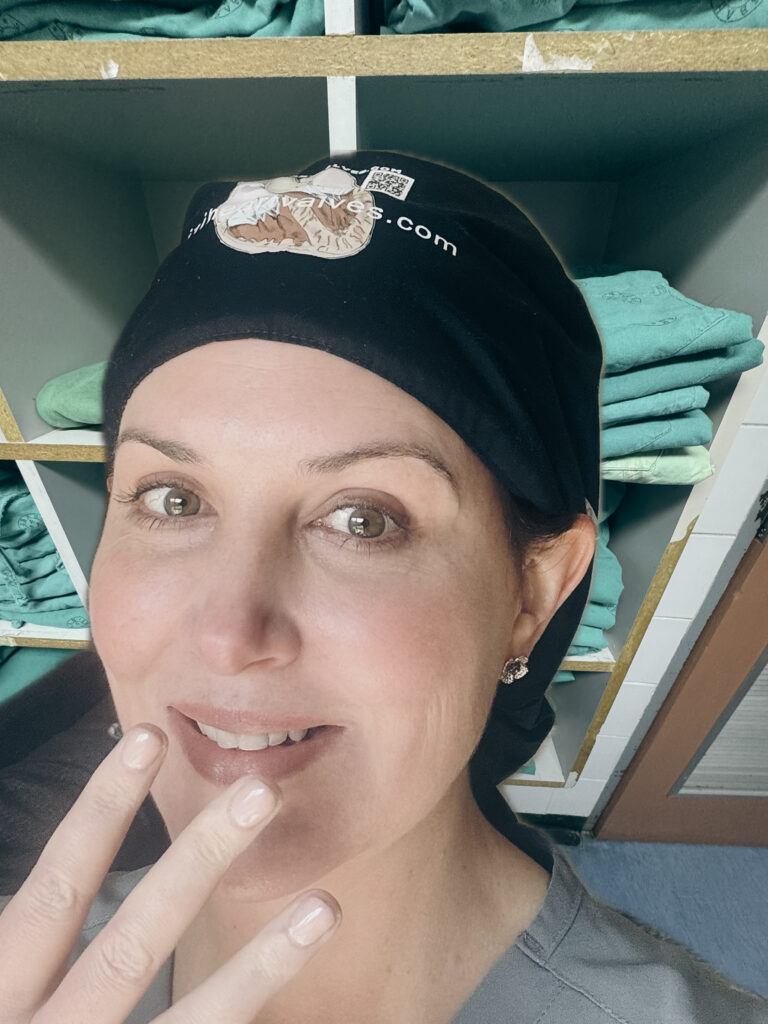
As for those wondering what colour nail polish I chose, I chose a conservative nude pink so the surgeon I visit will take me seriously and not perceive me as a scalpel-swinging Barbie doll.
I am only helpless while my nails are drying – unknown